Ultra-Wideband (UWB) Technology
Centimeter-precision ranging and the end of relay attacks.
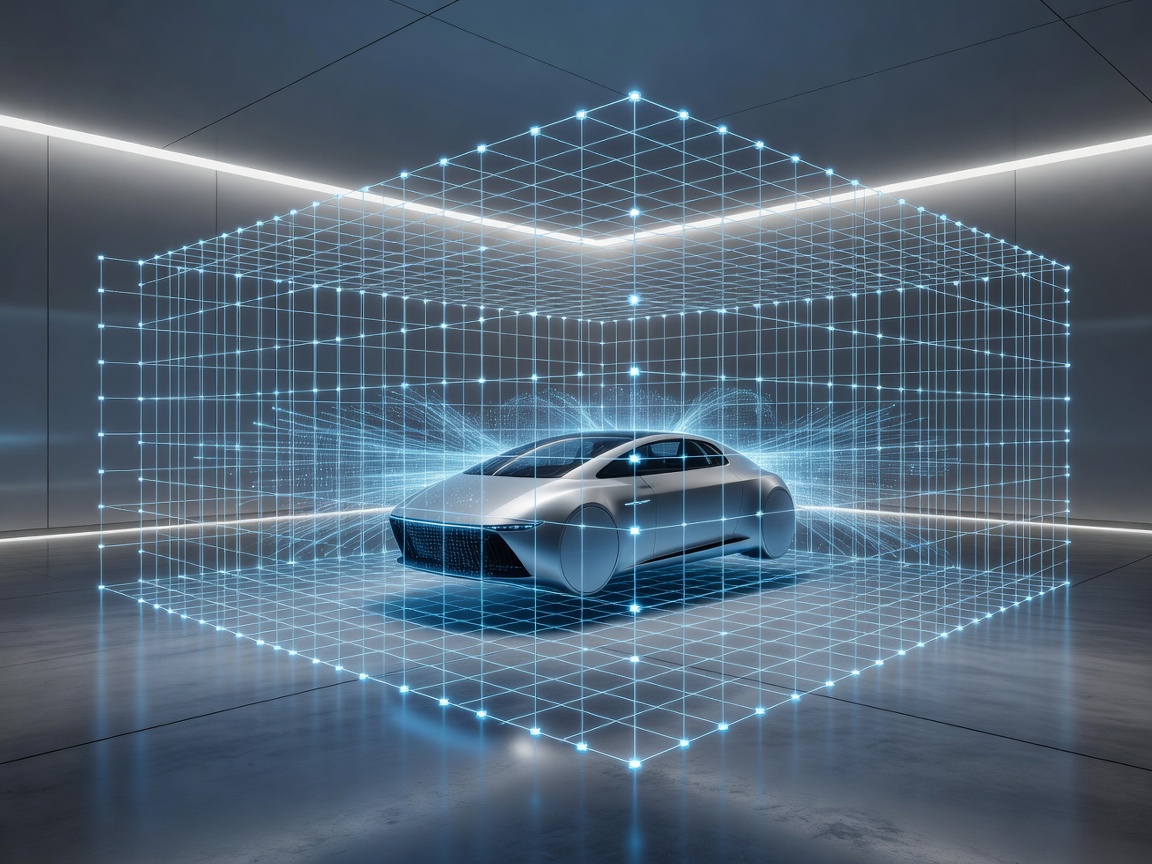
The Paradigm Shift in Spatial Awareness
For years, automotive access control relied on crude approximations of distance based on signal strength (RSSI). The integration of Ultra-Wideband (UWB) into modern smartphones—pioneered by spatial awareness chips like Apple's U1—has fundamentally transformed digital car keys. UWB does not guess distance based on signal volume; it calculates it based on the speed of light.
Time of Flight (ToF) Ranging
UWB operates across a massive frequency bandwidth (typically spanning 500 MHz or more, mostly in the 6 to 8 GHz range). It sends out incredibly short pulses of energy—billions per second. Because these pulses are so brief and sharp, the receiver can precisely pinpoint the exact nanosecond a pulse arrives.
This allows UWB systems to use Time of Flight (ToF) calculations. The vehicle's UWB node sends a pulse to the smartphone, the smartphone processes it, and sends a pulse back. By calculating the total time taken for the round trip minus the processing time, the vehicle knows exactly how far away the phone is, down to the centimeter.
Defeating the Relay Attack
The primary security advantage of UWB is its absolute immunity to traditional relay station attacks. In a relay attack, thieves use amplifiers to grab a signal from your keys inside your house and transmit it to the car.
With UWB, amplifying the signal does not trick the system. If an attacker intercepts a UWB pulse, amplifies it, and re-transmits it across a longer distance, that process inherently takes time. The vehicle's security module will measure the Time of Flight, detect that the response took a few nanoseconds too long, mathematically conclude that the phone must be far away, and deny the unlock request. You cannot fake the speed of light.
The UWB + BLE Hybrid Architecture
Despite its precision, UWB is relatively power-hungry and poor at initiating long-range connections. Therefore, automotive standards (like CCC Digital Key Release 3) dictate a hybrid approach.
- Discovery (BLE): At 10–20 meters, the car and phone discover each other using low-power Bluetooth.
- Authentication (BLE + SE): An encrypted tunnel is established, and cryptographic certificates are exchanged via the Secure Element over BLE.
- Ranging (UWB): The car activates its UWB transceivers to measure the exact distance and trajectory of the smartphone.
- Action: If UWB confirms the phone is within the authorized bounding box (e.g., driver's side door), the vehicle unlocks.
Hardware Requirements
Implementing UWB is hardware-intensive. A vehicle typically requires a minimum of four UWB anchors (e.g., behind the front and rear bumpers, and inside the cabin roof) to accurately triangulate the phone in three-dimensional space. This allows the car to know not just how far away you are, but whether you are standing at the trunk, the driver's door, or sitting in the driver's seat. If UWB determines the phone is sitting on the trunk lid, the engine start button will remain immobilized.
As smartphone manufacturers universally adopt UWB hardware, it is rapidly becoming the gold standard for secure, seamless digital automotive access.