Bluetooth Low Energy (BLE) Access
The foundation of hands-free "Passive Entry Passive Start" (PEPS) systems.
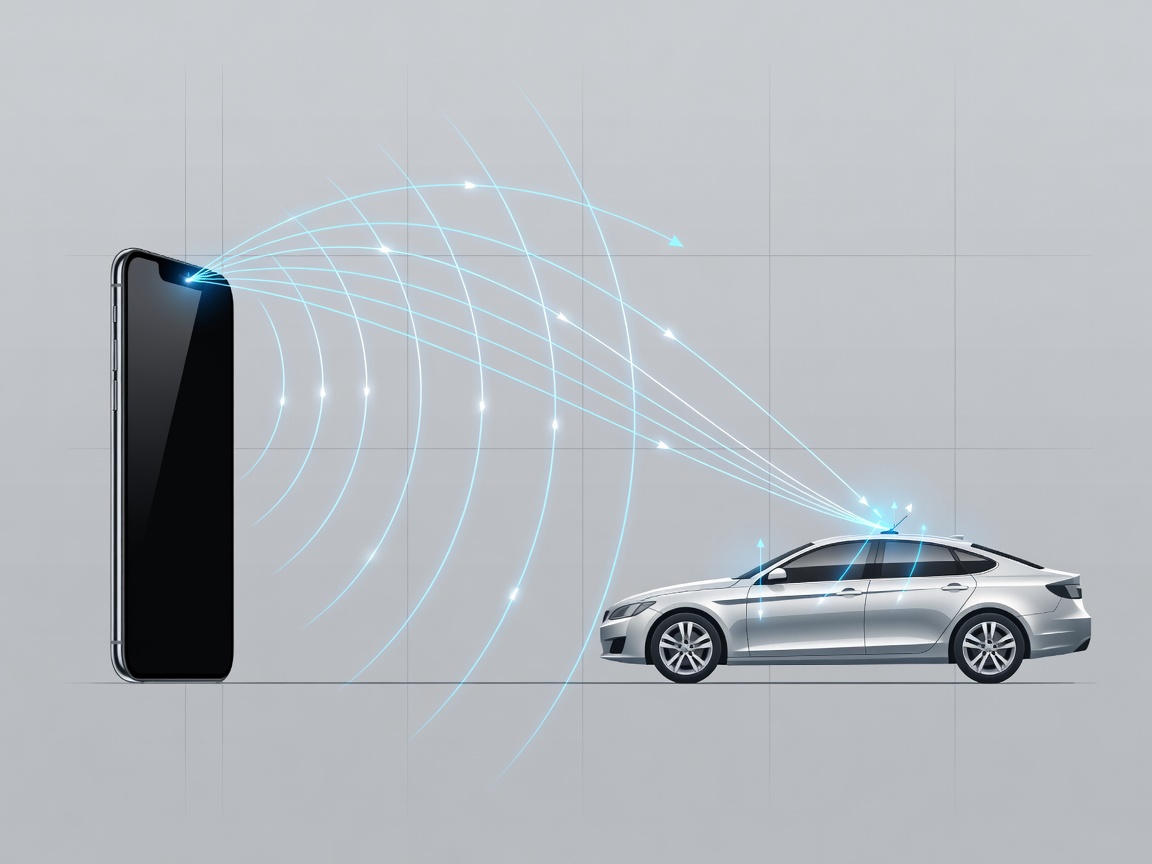
The Shift to Hands-Free Entry
While NFC requires deliberate physical interaction, consumers expect modern vehicles to mimic the convenience of traditional passive key fobs: walk up to the car, pull the handle, and get in. To achieve this via a smartphone, the automotive industry turned to Bluetooth Low Energy (BLE). Operating in the 2.4 GHz spectrum, BLE is universally available on modern smartphones and is highly optimized for power efficiency.
How BLE Proximity Detection Works
Vehicle entry via BLE relies on a concept known as Received Signal Strength Indicator (RSSI). By measuring how strong the Bluetooth signal is, the vehicle attempts to calculate the distance of the smartphone.
A typical modern car equipped with BLE access will have an array of antennas—often four to six—hidden within the door panels, bumpers, and center console. As you approach the vehicle, these antennas continuously poll the environment for the unique cryptographic beacon emitted by your smartphone's background OS processes.
When the car detects the signal, it wakes up the vehicle's onboard computers. As you move closer, the multi-antenna array triangulates your position. The system must confirm you are within a specific "unlock zone" (usually less than 1.5 meters from a door) before authorizing the latch to open. Once inside, the interior antennas must verify the phone is physically inside the cabin before the engine start button becomes active.
Challenges with RSSI Localization
While BLE is ubiquitous, using it for precise distance measurement is inherently flawed. RSSI was designed to measure signal quality, not spatial distance. The 2.4 GHz signal bounces off metal, gets absorbed by the human body (which is mostly water), and suffers from interference from other devices.
This leads to several well-documented issues in purely BLE-based car key systems:
- Multipath Fading: Signals bouncing off the ground or nearby vehicles can make the phone appear further away or closer than it actually is, resulting in a delayed unlock.
- Pocket Placement: A phone in a back pocket with the user's body between the device and the car will transmit a drastically weaker signal, often requiring the user to turn or shift to trigger the unlock.
- The Relay Attack Vulnerability: Because BLE relies on signal strength to determine distance, attackers can use signal amplifiers. By placing an amplifier near your phone (e.g., inside a coffee shop) and another near your car, they can trick the car's BLE nodes into registering a strong, close signal, thereby unlocking the doors.
Mitigating BLE Weaknesses
To combat these issues without entirely abandoning BLE, manufacturers have implemented sophisticated countermeasures. Channel hopping protocols ensure the frequency rapidly shifts to avoid interference. Machine learning algorithms process the RSSI data from all vehicle antennas simultaneously to model a probability curve of the user's actual location, filtering out sudden spikes in signal strength that indicate bouncing or amplification.
The Role of BLE in the Hybrid Key Protocol
Despite its localization inaccuracies, BLE remains an indispensable layer of the Car Connectivity Consortium's Release 3 specification. Today, BLE's primary role is not precise localization, but rather wake-up and secure channel establishment.
As you approach a vehicle, the long-range BLE connection wakes the car from its deep sleep state and establishes a secure, encrypted tunnel using Public Key Cryptography. Once this tunnel is formed over BLE, the actual distance measurement is handed off to a more precise technology like Ultra-Wideband (UWB), while BLE maintains the data transmission layer. This hybrid approach leverages the best of both worlds: BLE's range and compatibility, combined with UWB's mathematical precision.