NFC Car Keys: The Reliable Baseline
Understanding Near Field Communication in the automotive context.
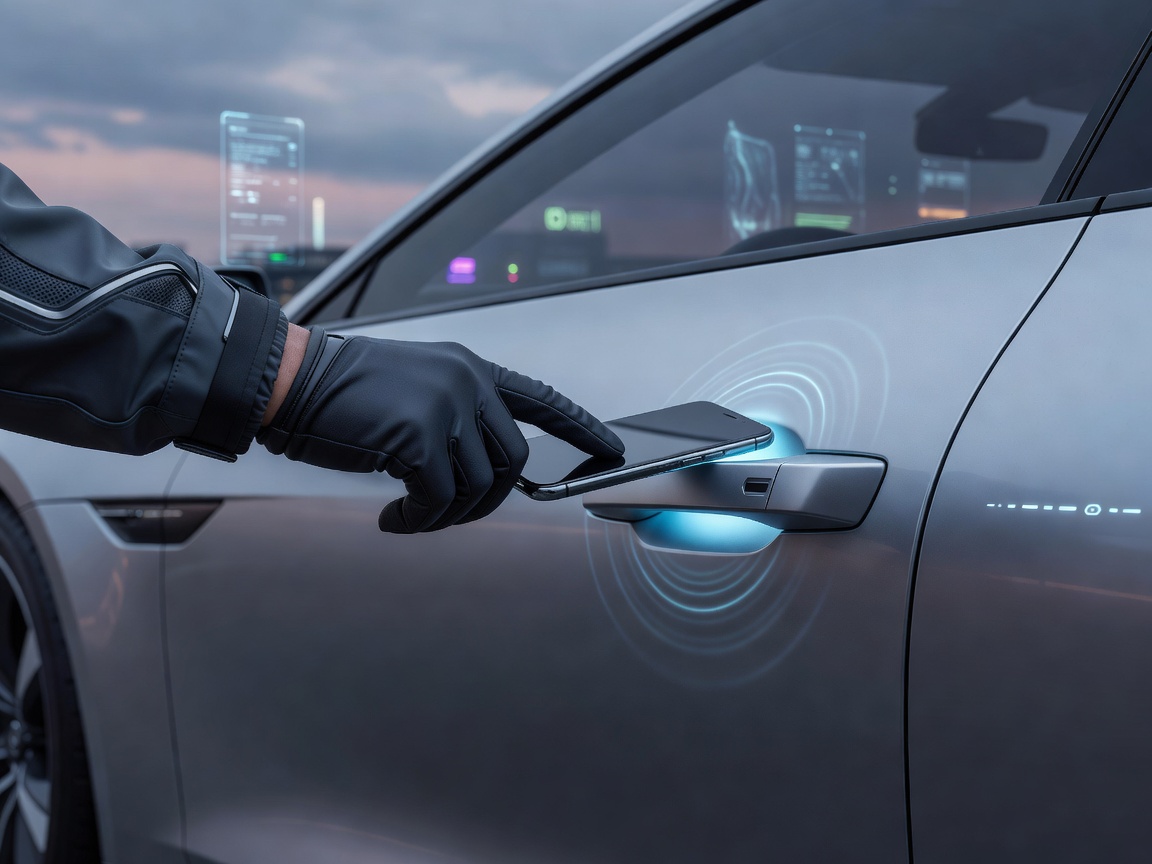
The Mechanics of NFC Entry
Near Field Communication (NFC) operates at a frequency of 13.56 MHz and is a foundational technology for modern digital car keys. While the automotive industry is rapidly adopting Bluetooth and Ultra-Wideband for seamless "hands-in-pocket" entry, NFC remains absolutely critical as a secure, intentional, and fail-safe authentication method.
Unlike longer-range wireless protocols, NFC requires the transmitting and receiving antennas to be within a few centimeters of each other. This physical constraint is its greatest security asset. An NFC interaction requires a deliberate physical gesture by the user—typically tapping their smartphone or smart watch against the vehicle's door handle or B-pillar.
Active vs. Passive Modes
A smartphone acting as a digital key primarily uses two modes of NFC communication:
- Card Emulation Mode: The smartphone acts like a traditional contactless smart card. The car's door handle houses the active reader which emits a low-power magnetic field. When the phone enters this field, the secure element inside the phone communicates the cryptographic tokens required to unlock the door.
- Reader/Writer Mode: Used less frequently for access, but occasionally utilized when the car is passing specific diagnostic data back to the phone during the pairing process.
The Battery Exhaustion Fallback
One of the most frequent consumer anxieties regarding smartphone-based car keys is: "What happens if my phone dies?" NFC provides the answer through an ingenious hardware integration known as power reserve.
Modern smartphones with dedicated Secure Elements (SE) are designed so that the NFC chip and the SE can draw trace amounts of reserve power directly from the battery circuit, even when the main operating system has shut down due to low voltage. In many devices, an NFC car key can remain functional for up to five hours after the phone's screen has gone black. Because the car's door handle emits an electromagnetic field, the phone's NFC coil can harvest a marginal amount of energy to complete the authentication handshake.
Security Considerations
Because NFC operates over such short distances, it is inherently resistant to the kinds of relay attacks that plague traditional remote keyless entry (RKE) systems. An attacker cannot easily amplify an NFC signal from inside a house to a car parked on the driveway, because the protocol demands tight timing and physical proximity.
Furthermore, automotive NFC implementations rely on the Car Connectivity Consortium (CCC) Digital Key Release 2 standards. Under this framework, the actual cryptographic keys never leave the phone's Secure Element. The NFC chip merely acts as a conduit for a challenge-response authentication protocol based on Public Key Infrastructure (PKI). Even if a malicious actor were to intercept the NFC transmission, they would only capture useless, single-use encrypted session data.
Pros and Cons of NFC Access
While fundamental to digital access, NFC is not without its usability drawbacks when compared to newer technologies.
| Advantages | Limitations |
|---|---|
| Works when phone battery is dead (Power Reserve) | Requires physically taking phone out of pocket |
| Immune to long-range relay attacks | Slower access than passive proximity systems |
| Highly standardized across hardware manufacturers | Precise antenna alignment required (can be frustrating) |
| Minimal battery drain on vehicle standby systems | Cannot be used for engine start without placing on a charging pad |
In the broader ecosystem, NFC is no longer positioned as the sole method of digital entry. Instead, it serves as the ultimate fallback mechanism—a reliable, secure layer ensuring you are never locked out of your vehicle.